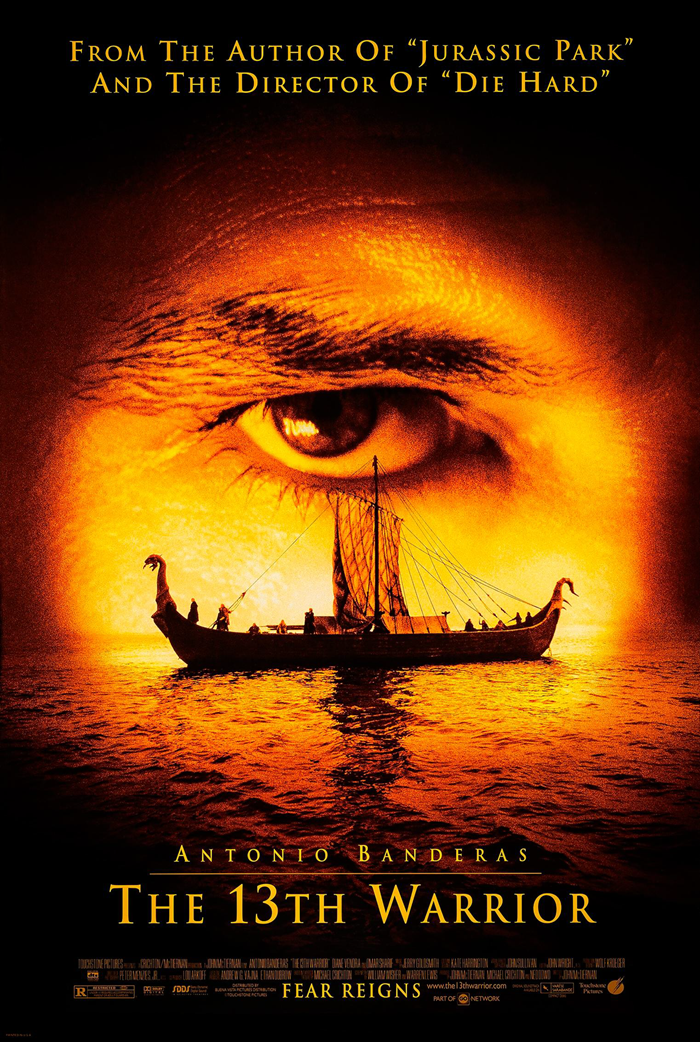
The 13th Warrior
Films occasionally request your attention; rarer still are those that seize you by the lapels and drag you -- mud-splattered and breathless -- into another century. The 13th Warrior belongs unapologetically to the latter category. Its opening sequence alone, a hypnotic swirl of language, firelight, and fatalism, may rank among the finest ever committed to celluloid. It does not so much begin as it summons -- conjuring a world that feels less invented than remembered.
Antonio Banderas, often relegated by lesser scripts to little more than a charismatic silhouette, here reveals the full measure of his dramatic authority. One is tempted to say he was born for the role, though that would undersell the intelligence and restraint he brings to it. This is not merely his finest performance -- it is the sort that quietly rebukes anyone who ever doubted his range. He does not play Ahmad ibn Fadlan; he becomes him, with a dignity and curiosity that anchor the entire enterprise.
Around him gathers a cast so uniformly convincing that one begins to suspect the filmmakers simply unearthed them from the 10th century. Vladimir Kulich’s Buliwyf is no cartoon chieftain but a figure of grave, almost mythic credibility -- a leader whose authority feels earned rather than declared. Dennis Storhøi, with a performance of ferocious subtlety, invests his role with a lived-in authenticity that borders on the uncanny. Omar Sharif, in his brief but essential contribution, narrates with such gravitas that one feels less as though hearing a performance and more as though listening to history itself.
Richard Bremmer, though not a Viking by birth, erases any such trivial distinction through sheer conviction; one would never suspect the artifice. Tony Curran, meanwhile, appears so perfectly attuned to his role that it is tempting to imagine he spent years in preparation, marinating in the very marrow of the age he portrays.
The production and set design deserve their own commendation, for they do not merely depict a time period -- they transport you into it. Every timber, every flicker of torchlight, every smear of grime conspires to create a world that feels tactile and immediate. The writing, too, operates on a level that transcends mere intellectual engagement; it is less an exercise of the mind and more a stirring of something spiritual, as though tapping into an older, half-forgotten rhythm of storytelling.
That the film was met with poor reception says nothing of its quality and everything of the audience’s unfortunate condition. One is reminded that blindness and deafness are not always physical ailments; sometimes they are cultural ones. The 13th Warrior stands as a testament not to failure, but to the enduring tragedy of brilliance overlooked.
Ciao. For Now.
-Ash
